Showing posts with label day-to-day. Show all posts

Tuesday, September 1, 2009

September?

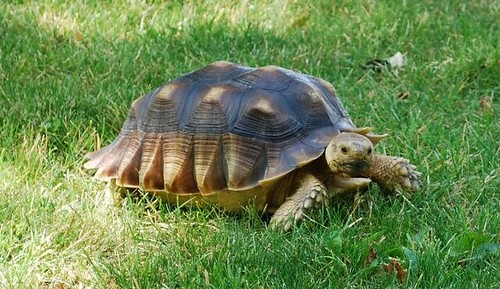
In my mind, September has always been the end of the summer. I think it has to do with spending so many years in school, and now working for a university. But the grass in the arboretum is still green and various individuals are out there enjoying it. Like this guy:
African tortoise zoomed

He's an African tortoise from the Biology department and lives in the Science Building, next door to our building. He was out today, getting some air and nomming some apples.

But I spend most of my time inside. Yesterday we were playing with the gallery furniture, testing out various arrangements in preparation for our opening exhibit. The mobile walls are really versatile! It was amazing to see the different ways in which our (more or less) rectangular gallery can be set up with the walls. Here's one view:
Gallery

It's really astounding to think of how far we've come since we started this blog nearly two years ago (wow! has it been that long already?). I'm really looking forward to seeing the exhibit up in the space. I think it's going to be really great.

Tuesday, June 23, 2009

Organizing History

This museum has been around, in one form or another, for 40 years. And we have the files to prove it. Unfortunately, those files have been in various offices and organized in various ways for 40 years, too. So, pretty much, it's a big mess.

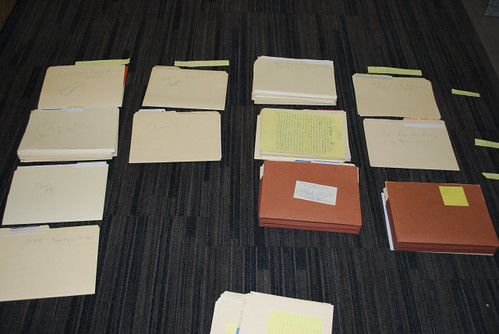
Organizing History

I've undertaken to (re)organize the files, using the office floor and a spread sheet style organizational system. It goes by decade across the top and topic along the side. The files out represent just a fraction of the total files.

I have recycled So Much Paper so far. Lots of old, irrelevant articles. Lots of multiple copies of memos or forms long out of use. Lots of paper taking up space which doesn't need to be here. So out it goes, keeping only what's relevant. Once this all gets organized by decade and topic, I have a stack of brand spankin' new file folders to put it in and put it away in an organized manner. ... and the stacks of files on the office floor will be gone!

Tuesday, June 9, 2009

Finals week!

It's finals week here at CWU and a lot of things are getting wrapped up around the museum.

The gallery lights have been replaced!

The security is being installed!

The collections are all unpacked!

The docent station (for the lobby) is almost finished!

There's a couch in the museum office (for visitors!)!

Walls and cases are being built!

We've signed the contract on our opening exhibit!

The corner display case has been built out so we can display things in it!

It's been a pretty productive week or two, I'd say. But with all of these awesome developments come some other final things. Four of the interns who've worked with me all year are graduating and moving on to bigger and better things. Thank you, Kim, Launi, Rachel, and Shena, for all of your excellent work with the collection this year. Best of luck in all of your future endeavors.

Monday, June 1, 2009

A Day in the Life

I've always said that one of the things I love about my job is the variety of things I get to do. Today was no exception.
Workspace
Note the enormous crate, we'll get to it later.

I got into work today and things started out pretty much in the usual way.
- I check my email and catch up on things from the weekend.
- I speak with the museum director about some grants that we've received and what sort of projects I have planned for the summer.
- My first intern comes in; I ask her to work on an inventory of the chipped stone (no small task).
- I begin to work on a short write up of collections work for the first annual report of the MCE.
- My first intern leaves, my afternoon interns arrive.
- I put them to work on rearranging the shelves and moving all of the shields and swords into the shelves(which take up a lot of space - this task condenses them significantly).
- A work study student arrives; she resumes a project researching the memoirs of our first donor for clues about the collections object.
- A biological anthropologist, for whom we've been holding a crate, comes down to say he's going to open the crate and take its contents up to his lab.
- The contents? A DNA sequencer. My nerdy delight is stifled somewhat when it doesn't look like an old school Star Trek computer with blinking lights and lots of knobs and buttons. It's actually a fairly nondescript tan metal cube.
- I help unload the sequencer and take the debris from the crate out to the dumpster.
- I continue working on and finish the draft of the collections work write up. I email this to the director.
- I work on intern evaluations.
- The afternoon interns finish up for the day and report on where they left off.
- Work study student wraps up for the day and heads home.
- I assemble the Shop Vac which arrived a couple of weeks ago and
- I clean up the small bits of wood and styrofoam left behind from the crate and packing materials.
- I decide that today passed so quickly that I should go blog about it.
- And I do all this while dressed nicely enough to go to a reception at the President's house half an hour from now.

And somewhere in there I found time to go get my espresso drink of choice (double 20 oz iced white chocolate americano with cream (and to think that only two years ago I had never had coffee! This is what moving to Seattle does to a midwesterner.)) and to eat lunch.

So! All in all, a pretty eventful day!

PS: Why is it that my post titles always make me think of songs?

Friday, April 17, 2009

Growing pains

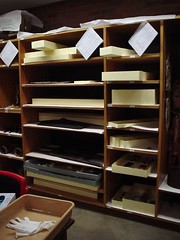
Have I mentioned the compactor storage? I'm sure I did. The compactor unit is a rolling storage unit, like you see for files at some medical offices, or in the stacks of some libraries. It makes the most of the space in small areas... or large ones. Our particular unit has seven large units, although the two at the ends are half width. They're 27' long and 10' tall. Essentially, these are enormous shelves. And super for a museum to have.

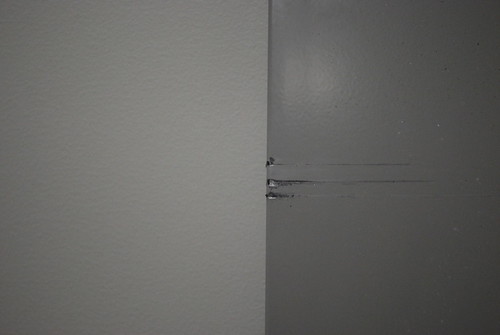
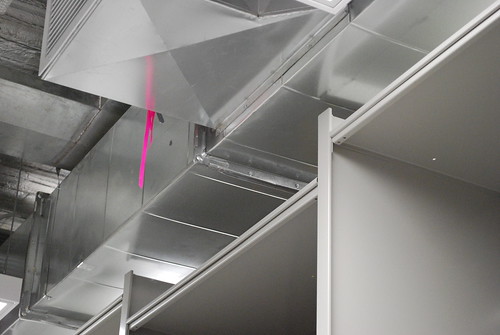
But last week Friday we noticed something alarming; the top of a couple of our units were scraping an air duct in the ceiling. The duct would move from side to side and the compactor unit was somewhat hard to move. So we took the tops off of the affected areas (Thankfully all the shelves, including the tops, are adjustable.) We could plainly see the areas where the ducts and shelving were rubbing.
Compactor problems

This week we came back to it and replaced the tops, slightly lower than they were before. This seems to have solved the problem. We're not sure when the problem began, but we're glad it was relatively painless to solve. Especially so, since we hadn't placed anything on the shelves below the affected areas. In the photo below, the two shelves on the left side have been lowered somewhat. You can see that there's really not a lot of space wasted in this room!
Compactor problems

Friday, April 10, 2009

Surprises

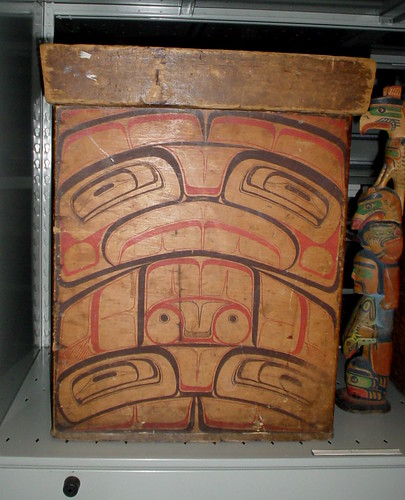
There are two Pacific Northwest bentwood boxes in the collection. The four sides of bentwood boxes are made of a single plank bent into the shape of a box. These boxes are often beautifully decorated with formline animals and motifs. Boxes were used for cooking in and storage. They were often very highly prized possessions within families. To see more Bentwood boxes, take a look at this page of bentwood boxes from the collections of our neighbors at the Burke Museum in Seattle.

But this post is titled "Surprises," not "all about bentwood boxes." When we moved the box pictured below, we removed the top of the box. The top is quite heavy, and we didn't want to have the top falling to the ground while we moved the box (I shudder at the thought of dropping collections objects). As we were lifting and moving the box, we noticed an odor... a very distinctive odor... fish! More specifically, smoked fish - salmon I think. It was a surprise to find such a vivid reminder of the past history of the box hiding just out of sight.
Bentwood box
As soon as we could, we closed the box up again, hopefully preserving this amazing experience for future individuals. It is now sitting safely on its new shelf here in Dean Hall.

Little surprises like this are part of what I love about working with museum collections. It's very detail oriented work, so sometimes I discover that the soles of a pair of moccasins were recycled from an earlier use, and sometimes I discover that a pair of sandals was once infested by many many hungry bugs (which is less delightful). And sometimes I discover something which can't be seen, like the smell of salmon in a bentwood box. It's very cool.

Friday, August 8, 2008

Summer Vacation

Adventures in Collection Management will be quiet for the next couple of weeks as I go embark upon some vacation adventures.

I've spent today getting things in order: Cleaning up the work room, picking up and vacuuming the collections rooms, returning my library books. I've spent some time during this past week reading up on Columbia River Basketry and am now much more informed on the subject than I used to be. Reading about how time consuming basket making is and how vital baskets were to life in eastern Washington gave me an entirely new appreciation of the many baskets in our collection. The book linked above, Mary Dodds Schlick's Columbia River Basketry: Gift of the Ancestors, Gift of the Earth is an engaging read, and accessible. I would recommend it to any looking for an introduction to the baskets of this region.

See you at the end of the month!

Monday, July 7, 2008

Back to work!

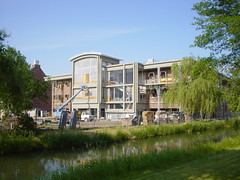
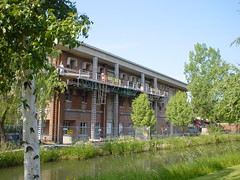
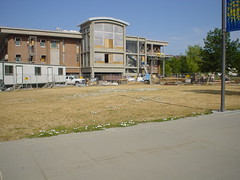
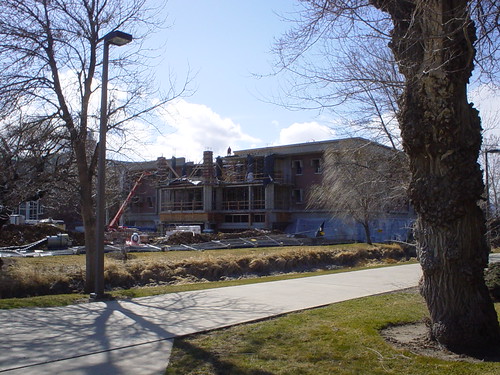
Here in the US, we're coming back to work after a long weekend. I've got a list of projects to tackle this week which include processing some objects which had not been cataloged or photographed, some database cleanup, and some filing. In the meantime, here are some photos of the new building, coming along nicely. I may have mentioned this, but the museum will not be occupying the entire building; instead, it will have a nice suite of spaces on the first floor. The Anthropology and Geography departments will make up much of the upper floors.

As always, click through for larger images.
The addition to the front of the building is coming along very nicely.
Dean Hall July 1, 2008

The bottom floor walls have been put up.
Dean Hall July 1, 2008

It's quite a dry region here; you can see what the grass would look like if it wasn't watered regularly (most of the campus is).
Dean Hall July 1, 2008

Thursday, June 19, 2008

Summer Daze

I've been doing computer work for the past couple days and my eyes hurt from staring at the screen. But it's all for a good cause. Projects underway include making a list of objects we have records for but no recent inventory of, figuring out how many chipped stone pieces we have (answer: about 6500), cleaning up the database, and some good old data entry.

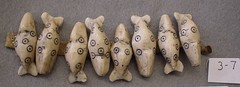
I'm off to give my eyes a rest and work on a couple of issues that cropped up during the chipped stone count. I leave for you a completely unrelated image of small carved whale toggles - photographed and cataloged in 2007.

Carved whale pieces

I'll be back tomorrow with the first Whatzit of summer!

Monday, June 9, 2008

School's out!

"Intellectual control" is a huge concept in museums. It's not to be confused with intellectual property which also happens to be very important. Intellectual control means that a museum can account for its objects, their history, their ownership, and so on and so forth. It's knowing where objects came from and where they are and if they should stay where they are. (By the way, if there are museum professionals out there with a better definition of intellectual control, please share.)

When I came to this museum, I was happy to find that a good level of intellectual control had been established over most of the collection - most objects have numbers which relate them to donors, and the database allows most objects to be easily located.

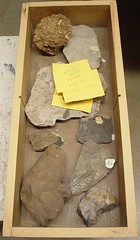
box of rocks

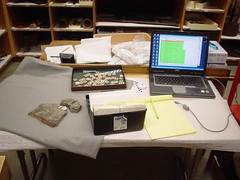
But nothing's perfect. There are several boxes of rocks, like the one above, mostly geologic specimens and fossil leaf impressions, which have escaped cataloging for the most part. Over the past week or so, I've been working in one of the store rooms beginning to sort out these specimens. I've set up a mobile command center at which I can sit and listen to my local NPR news station while I catalog, measure, and photograph these objects.

makeshift office

I'll be honest; these rocks are a challenge. Many of them have duplicate numbers. That is, they have the same catalog number as a different sort of object entirely. Some of them were labeled with a number on a sticker and the sticker has fallen off. It's my task to figure out how to identify these objects in our records. Before I make that decision, I am determining the extent of the duplicate issue. The two primary options that I see at this time are to 1) add a letter after the catalog number (duplicate 8-57 might become 8-57G (G for geology?)), or 2) assign new numbers which would come after the last catalog number for the accession. Both seem plausible. Option 2 seems reasonable given that most of the labels are not applied directly - they're on stickers which are falling off already.

No matter what I ultimately decide to do (and I am open to opinions and alternatives), I am going to document the heck out of it. Part of intellectual control is knowing the history of the object to the greatest extent possible. So if 8-57 is reassigned the number 8-514, for example, I would record that on both the paper catalog card which exists, and in our PastPerfect database. This way future collections managers will be able to avoid potential confusion.

On the flip side of the duplicate number issue is the missing objects issue. Going through these boxes have revealed many objects which were earlier unrecorded in the database and had been presumed missing. So for these objects, it's a happy ending straight away!

Friday, May 30, 2008

Got to have the right tools

for the job you're doing. You may have noted that one thing I really like to talk about are the supplies needed to do this job properly. This post is another in that vein.

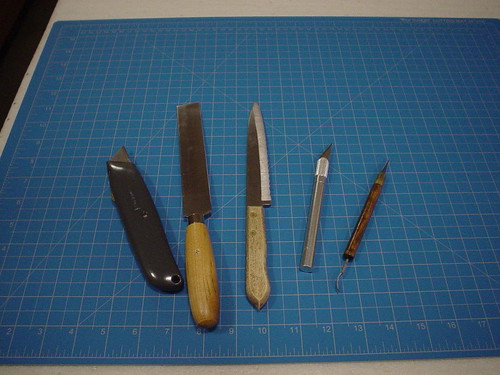
One class of tools we frequently use is cutting tools.
Cutting tools

When making boxes, cutting foam, etc, we need to use a sharp edged object.

On the left is a box opener, like you'd find in any hardware store. This is used for cutting cardboard, cutting foam, and sometimes, yes, even opening boxes.

Second from the left is our newest cutting tool: A foam knife. The foam knife is a thing of beauty. We often use 2" thick blocks of ethafoam which can be tricky to cut with smaller, less stiff knives. The interns who work with me have found that this foam knife makes precision work with the foam much easier. Frankly, I am pretty excited by the usefulness of this knife.

In the middle is a plain old kitchen knife. I picked it up for $.49 at the local thrift store. It has served well for cutting foam, but with the presence of the foam knife, it may no longer have a purpose.

Second from the right is a trusty standby: the Exacto knife. Excellent for precision work, cutting thin material, or poking holes through cardboard.

And on the far right is a blade similar to the exacto, but with a useful hook tool at the opposite end.

Not pictured is the noble scissors. Scissors are used from time to time to.... you guessed it, cut things. Notably for cutting tyvek or acid free tissue off of a roll and into shape.

Also not pictured: The First Aid Kit. When one is working with sharp tools designed to cut things, it is important to have adequate first aid supplies on hand. So far we have had no serious injuries. Primarily I've gotten paper cuts from the cardboard which sting like the dickens but are note serious.

So those are the sharp things we use to make proper housing for the many museum objects we care for. In fact, we actually have a drawer with many more exacto type knives and a couple more box cutters. And replacement blades. In the photo above, the blades are sitting atop a self healing cutting board, another extremely useful tool when cutting cardboard and other materials, as it keeps the blades from dulling against hard surfaces and keeps hard surfaces from being marred by blade marks. All tools of the trade.

Friday, May 16, 2008

Environmental Monitoring

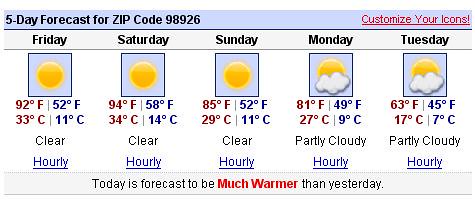
Summer is coming! At least it is according to the Weather Underground.
5.16.2008 weather

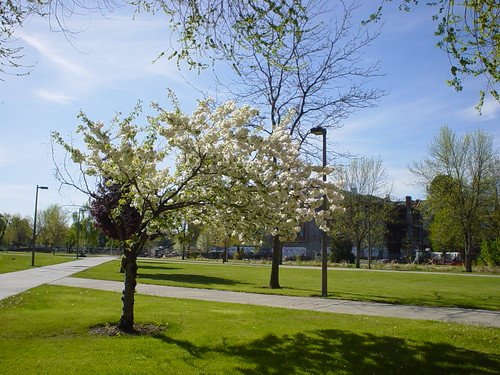
It still looks a bit like spring outside.
5.16.2008 blooms

Okay, but what does this wonderful turn in the weather have to do with collections management, since that's why we're all here? Well, let me tell you! So the point of collections management is to maintain and protect collections from deterioration. One thing which causes the deterioration of collections is environmental conditions. That is, things stored at the wrong temperature or at the wrong relative humidity can deteriorate faster - just imagine what would happen if you stored your books in the bathroom, with all that water in the air. They'd wrinkle and crease, and maybe start growing mold. So you can see why it's important to keep an eye on the environmental conditions.

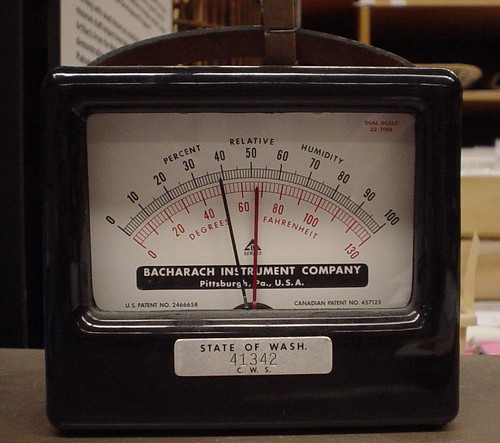
Our storerooms have dial thermohygrometers which indicate both the temperature and the relative humidity.
thermohygrometer

When we move to the new building, I will be using a very popular digital device called a datalogger which will perform the same function, but at a high degree of accuracy and consistency (I'll admit, sometimes I miss a day here and there, not to mention weekends.)

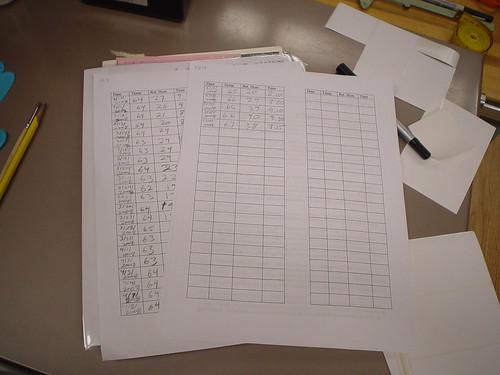
And to keep track of changes, I take down the reading every weekday morning. In this way I can keep track of trends over time.
monitoring sheets

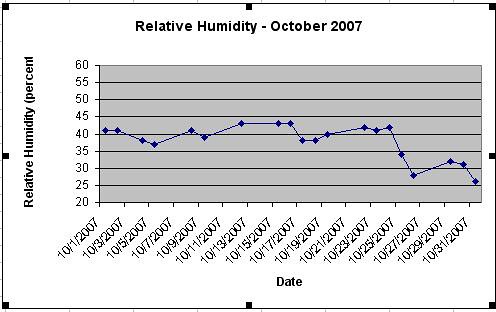
It's not rocket science, it's not even fancy, but from these readings, I can generate excel charts showing the change over time, like this one from last October for relative humidity:
Relative humidity

You'll see on that chart a relatively sudden drop in relative humidity(RH) - in about 2 days it drops 15%. That means the air got a lot drier pretty quickly. When changes happen suddenly like that it can put a lot of stress on sensitive objects, causing cracks, pieces falling off, and invisible damage that will accumulate over time.

This subject is of special interest right now because this week I saw a jump of about 15% in RH in a couple of days. I also found a document in the files from the 1970s, when the building the collections are in now was being built. It indicated that the entire building was environmentally controlled and would have a building wide RH of 45-55% (a standard 'normal' setting). But my tracking has shown that this environmental control has faltered somewhat over the years - RH in one storeroom spent much of the winter under 20%.

So what does this all mean? It means that our storage rooms have less than optimal environmental conditions. What can I do about this? Not a whole lot, really. I can monitor it, be aware that this may cause condition problems for some of our objects, and make plans to improve things in the future.

And I can spend some time in the sun this summery weekend, enjoying the natural environmental conditions.

Wednesday, April 9, 2008

These boots were made for walking....

but now they're in a museum so no one is allowed to use them for walking, running, dancing, or even hanging out on the couch watching tv. And they're not boots, really, they're moccasins.

Over the past couple weeks I spent some time rehousing the moccasin collection. We have 17.5 pairs of moccasins, ranging from so tiny that they must be for a doll to mens sizes, and 1 pair of child's mukluks. Some of them were pretty much flat after being in storage for years (you know how a light canvas sneaker flops over? It's kind of like that. Shoes don't always hold their shape.), while others had some paper stuffing which gave them some support.
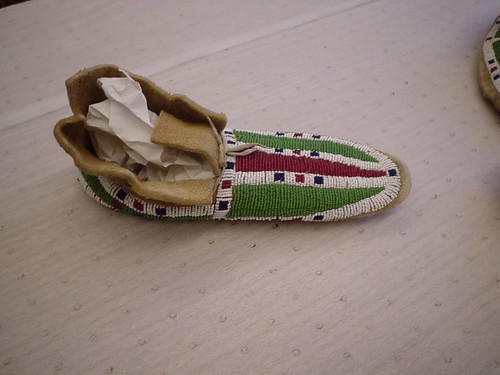
Original stuffing.
None had storage which allowed easy lifting while minimizing physical contact. So, taking a page from the Minnestoa Historical Society (which has really excellent information on their website, by the way), I set out to make custom supports for the moccasins, both internal and external.

I started with the moccasins, like this one. It had no internal support, although the large amount of beading held the shape of the foot fairly effectively.
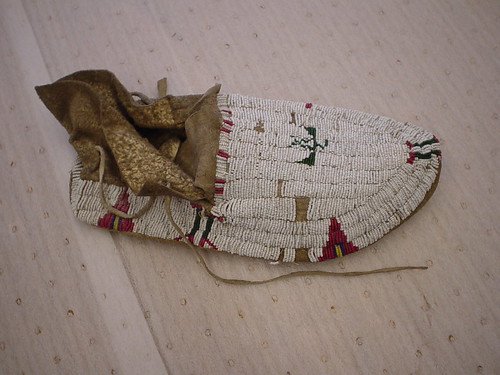
Pre-stuffing

Then I looked at what I had on hand: Cotton stockinette fabric, polyester quilt batting, scissors, and a sewing kit. The scissors, by the way, are distressingly dull. Must remember to sharpen those sometime.
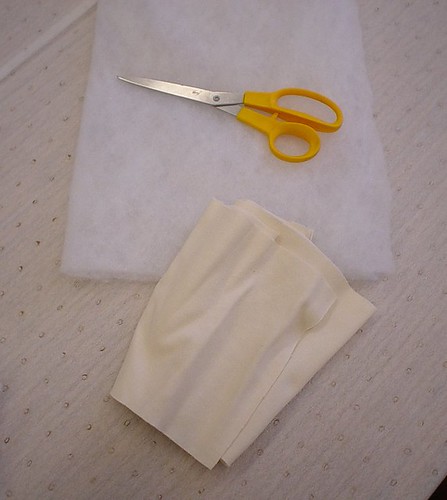
Materials

For my first try, I made a rectangular pillow:
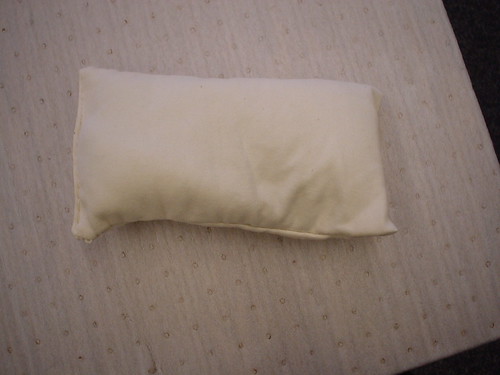
Experiment one: Rectangles

Okay, so it was approximately rectangular. I'm a collections manager, not a seamstress. But look how nicely it supports the back of the moccasin:
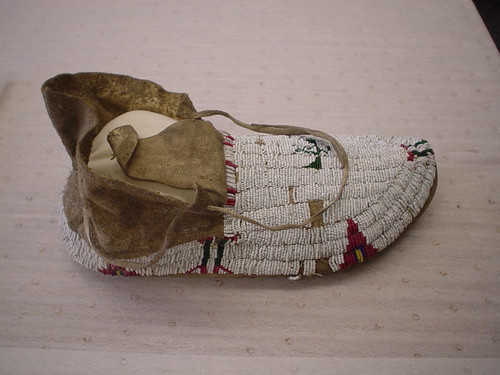
Stuffed form

But, it occurred to me, feet are not rectangular. So the rest of the moccasin support inserts were made to be roughly foot shaped. Again, I emphasize roughly.
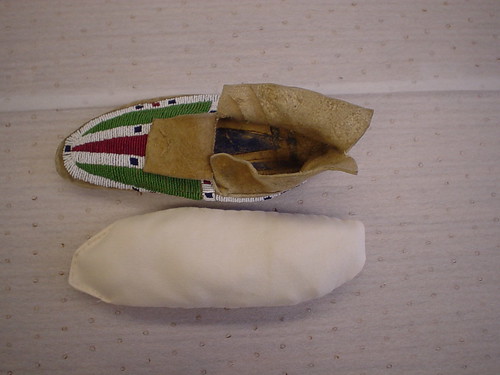
Experiment 2:  Vaguely foot shaped ovals

And check out the sole of the shoe above. Looks like it was recycled from a parfleche, or some other similarly decorated object.

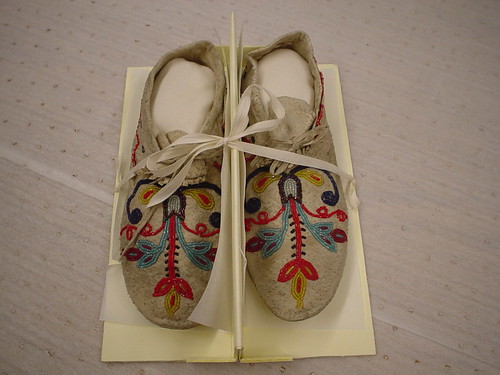
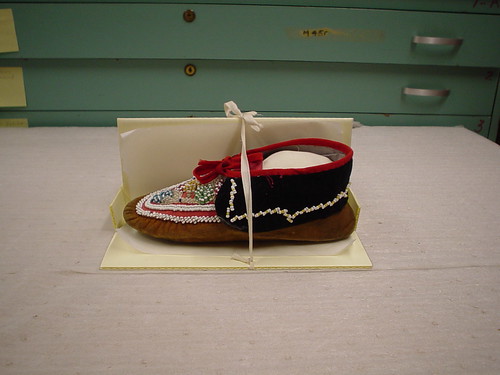
And finally, after sewing 33 supports, all the moccasins were supported. I endeavored to recreate the external support which the MHS had utilized, and, ultimately, I think it worked out pretty well. Ours are made of acid free card board with a tissue paper layer on which the moccasins sit (because the cardboard is buffered and the tissue paper is not).
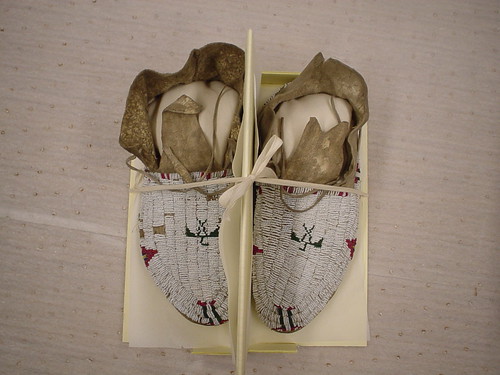
Top view

Top view

Side view

The freshly housed moccasins were returned to their wooden drawers where they will patiently await the move to a new facility.
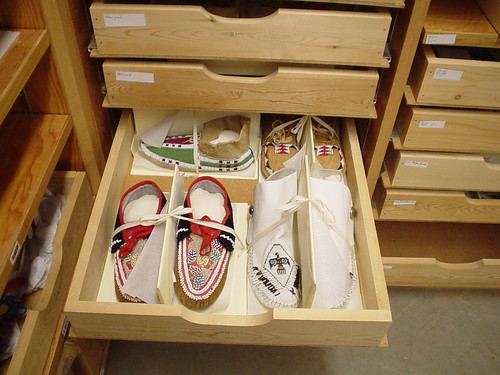
Drawer storage

Ultimately, this kind of storage will reduce the need for handling the moccasins which will help preserve them for a longer time. Feels like a happy ending to me!
Tuesday, April 1, 2008

Happy April Fool's Day!

April Fool's Day is a good a reason to post as any. No shenanigans will ensue, I promise. (although, check out this post from the Science Museum of Minnesota's Science Buzz Blog.)

Back in the day I would post three times a week, but now we're headed toward almost 2 weeks without a new post. I've got one in the works about the latest rehousing project I've taken on. Beaded moccasins. I won't say much about it, but I will say that I have spent much of the last week poking my poor fingers with sewing needles and pins (accidently, of course).

This quarter is going to be very very busy, I think. There are 7 (seven!!) students working with me this quarter. I foresee a great deal being accomplished.

(Why is it that blogger seems to remove the spaces between my sentences? Is it Firefox? Because I promise I'm spacing twice between each sentence and am not trying to confuse your eyes.)

Friday, March 21, 2008

Progress Report

This week is Spring Break for Central Washington University. That means that it is extremely quiet in the building, which normal bustles with undergraduates during daytime hours. The quiet has given me a chance to take stock of progress. But first, a progress shot of our future museum home:

Dean Hall construction 002

The Dean Hall renovation is progressing! The bottom floor walls have been moved out - I can see framing for them around - and the front of the building is being added on to. Dean Hall will house more than the museum; it will also be home to the Dean of the College of the Sciences, the Geography Department, the Anthropology Department, and several large classrooms. But it's exciting to see progress being made.

Progress is being made inside the museum as well. I had three hard working interns helping me this quarter. They worked on a variety of tasks including cataloging, rehousing, photographing, and updating the PastPerfect records for nearly 250 of our collections objects. Receiving special attention was our collection of West African material, including many pieces of jewelry, our collection of spears, arrows, and bows, and our collection of Southwest Pottery. I cannot thank these interns enough for their hard work, and am grateful that two will be returning for the Spring Quarter.
Updated housing

Updated housing

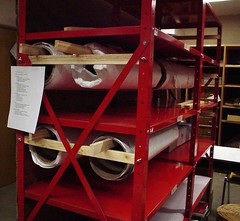
In addition, Anthropology 362: Curation and Collections Management researched our small collection of Navajo weavings and rehoused them. Previously, these textiles had been half-rolled, half-folded, but now they are rolled and hung on our impromptu textile storage rack.
Updated housing

So we've made some really excellent progress this quarter, and I think we're going to make some really excellent progress next quarter. We've come a long way, but there's a great deal more work to be done.

Wednesday, January 16, 2008

SPOON!!

Not, SPOON!, as in the battle cry of The Tick. But spoon as in a utensil used in the preparation, distribution and consumption of food.

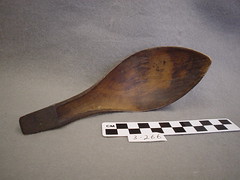
3-266, Northwest Coast Wooden spoon

I've been making slow and steady progress through small portions of the collection. One of my projects this week was the rehousing, cataloging, and photography of a small collection of Northwest Coast wooden and horn spoons. The above is pretty typical of the wooden spoons, undecorated with a large bowl.

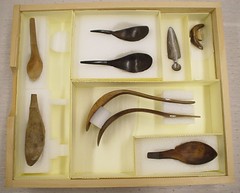
I should have taken a "Before" picture of storage, but I missed my chance. This is how the spoons are stored now:
Spoon Storage

I made custom cavities in 2" thick ethafoam for the smaller spoons. The larger spoons are required by space constraints to lay on their sides for the time being. They will be given custom mounts when we have moved. Some of the boxes are not permanent, thus there are some foam spacers in boxes to prevent the movement of the mounts. The boxes are custom made as well. And now the spoons are just about ready to be packed and moved, which is the ultimate goal.

Friday, December 21, 2007

Last post of the year

Well, it's the last day here before I leave to visit family for the holidays. It's been a good year - I think we've made a lot of progress. And a lot of credit must go to the three dedicated student volunteers who contributed over 100 hours of their time this quarter. They were instrumental in updating the database with our old catalog cards, in making a HUGE dent into the unprocessed lithics which have been hanging around the museum for years, and in beginning to catalog the collections.

We've also done a lot of work toward creating and implementing policies for the collection and the structure of the museum.

Objects are being housed in archival materials, and in a way that will be safe for the move. Objects, like the one below, are having their picture taken for the database.


Carved bear, collected in Alaska. Similar to carvings dated to 100 to 300 AD in Allen Wardwell's "Ancient Eskimo Ivories of the Bering Strait."

A lot has been accomplished this year, but we're going to do a lot more next year. House and catalog pretty much all the objects. Ready the collection for a move. Finalize the policies and structure of our new museum. Involve more students, interns, and community members in the process. Yep, we've got a lot of work ahead of us, but I think it will be a good year.

Wednesday, December 19, 2007

Ears, Nose, Throat, and Museum?

I guess you could say that I'm part of the Google generation. I turn to Google products multiple times every day. I blog on Blogger, which is owned by Google. My primary email is through gmail, I use Google maps to find where I'm going, and I use google search to find the answers to my questions.

Today I was thinking about the furs and hides in our collection. We have a large sheep or goat hide with fur intact and more than one tanned or semi-tanned leather hide. As part of a class project in the Winter quarter we're planning on rolling many of our Navajo rugs and Mexican textiles. At some point it came up that we might roll the fur.

My collection manager instinct said that rolling a hide was not ideal, but I've been trying to find out if this is true. So I googled "fur museum storage" or something quite close, and I found this page on preserving fur and leather. But something seemed funny. Why was this information coming up on a website for Otolaryngology? That's the fancy word for ear, nose, and throat doctors. Apparently, like many professional associations, they have a museum. And their museum provides pages with rather general info on all kinds of collections. How about that?

The otolaryngology page does say that leather and furs are but stored flat, but I'm going to check out some more google results to corroborate this.

Thursday, December 13, 2007

Renovations

In some ways, museum work is all about renovations. We're constantly developing better methods to preserve objects, better ways to communicate ideas to the public, and better ways to involve the public in the sometimes esoteric world of the museum (constantly proved esoteric by the movies - we won't go into the various inaccuracies in such films as Night at the Museum).

What I've been doing for the short time I've been at this museum is renovating, improving the museum methods in place. And at the same time, a construction company is renovating a building on campus where our new museum is going to be. It doesn't look like much now, but, from the plans and the drawings I've seen, it's gonna be pretty cool.

But for now, it's under construction. They're gutting the building, which is fun to watch, fun to see through the building. Click on any of the photos to see them at full size.


And this is the front of the building - facing the university commons.


Like the collections, the building is a work in progress. But we're both moving forward everyday and getting a little closer to the goal of having a modern museum with a dedicated exhibition space and a modern storage facility. And that's pretty exciting.

Wednesday, November 7, 2007

Cleaning House

This is a post about everyone's favorite activity: Vacuuming!

Yup, I vacuumed this morning. The collections storage area was sorely in need of some attention. In an ideal world, collections storage areas should probably be vacuumed once a week or once every two weeks. These rooms have not seen the suction power of a HEPA filter machine in about two months.

But I rectified that today, wiping out the tiny dust bunnies growing in the corners and cleaning up some of the tiny scraps of paper that made their way to the floor in the last 8 weeks. And now the floor is relatively clean.

Keeping museum collections spaces clean is very important. It helps to keep pests out and to identify when pests are present. It discourages dust from accumulating in the room and on the object. It is doubly important when collections spaces are not specially designed for collections. This space has door with gaps at the bottom and top and are relatively near exterior double doors through which the strong dusty wind of Ellensburg, WA blows whenever anyone enters or exits. So dust and dirt entering collections areas is a very real concern.

But the space is clean today and I plan to maintain it on a more regular schedule than I had during these past two months.