Adventures in Collection Management will be quiet for the next couple of weeks as I go embark upon some vacation adventures.
I've spent today getting things in order: Cleaning up the work room, picking up and vacuuming the collections rooms, returning my library books. I've spent some time during this past week reading up on Columbia River Basketry and am now much more informed on the subject than I used to be. Reading about how time consuming basket making is and how vital baskets were to life in eastern Washington gave me an entirely new appreciation of the many baskets in our collection. The book linked above, Mary Dodds Schlick's Columbia River Basketry: Gift of the Ancestors, Gift of the Earth is an engaging read, and accessible. I would recommend it to any looking for an introduction to the baskets of this region.
See you at the end of the month!
Friday, August 8, 2008

Monday, August 4, 2008
Quiet Summer
August! Already!
Summer is a time for getting things done. We've put in a lot of time getting a website ready. The text is written, the photos are burned to cd, the cd has been handed off to our web guru. If all goes according to plan, the museum should have its first official public-facing web presence by the end of September. It's not going to be anything groundbreaking, not at first, but it is exciting for us to take these steps. I am absolutely, positively going to give you a heads up when the website is up.
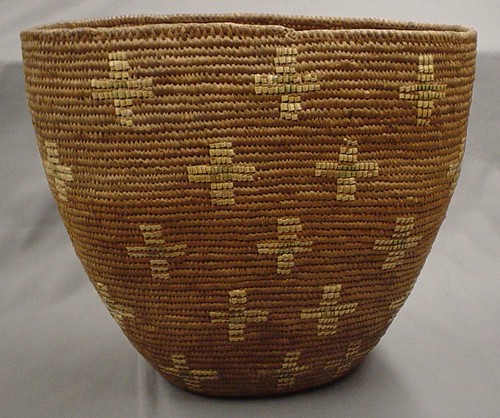
See that basket? It's one of two baskets chosen to be a part of the website header. This basket represents the kind of baskets used on the east side of the Cascades and by Interior Salish speaking people. This kind of basket was often used for picking huckleberries or root gathering. We chose baskets to be part of the header because baskets are not only beautiful objects, but also speak to the mission of the museum. Baskets were usually constructed from natural local materials for the purpose of gathering and storing natural materials. For a museum focused on the complex interaction between people and the environment, baskets of this type can tell many stories.
This basket will also, likely, be the first object profiled on the website as a "Highlight of the Collection." But first I need to do more research on it, so I can better tell its story.
Summer is a time for getting things done. We've put in a lot of time getting a website ready. The text is written, the photos are burned to cd, the cd has been handed off to our web guru. If all goes according to plan, the museum should have its first official public-facing web presence by the end of September. It's not going to be anything groundbreaking, not at first, but it is exciting for us to take these steps. I am absolutely, positively going to give you a heads up when the website is up.
See that basket? It's one of two baskets chosen to be a part of the website header. This basket represents the kind of baskets used on the east side of the Cascades and by Interior Salish speaking people. This kind of basket was often used for picking huckleberries or root gathering. We chose baskets to be part of the header because baskets are not only beautiful objects, but also speak to the mission of the museum. Baskets were usually constructed from natural local materials for the purpose of gathering and storing natural materials. For a museum focused on the complex interaction between people and the environment, baskets of this type can tell many stories.
This basket will also, likely, be the first object profiled on the website as a "Highlight of the Collection." But first I need to do more research on it, so I can better tell its story.
Tuesday, July 15, 2008
Fragile objects
There are many fragile objects in this collection - feathers, beading, paper mache masks, broken glass bottles - but there are some objects that make me nervous just looking at them. This partially reconstructed bowl is one of them:
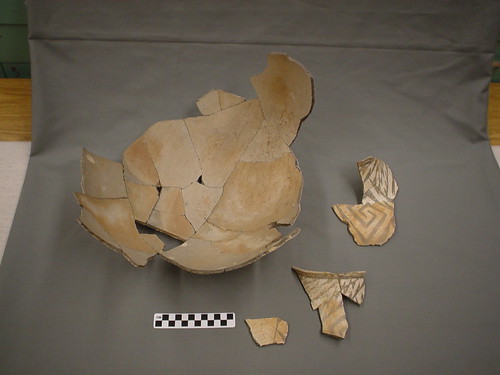
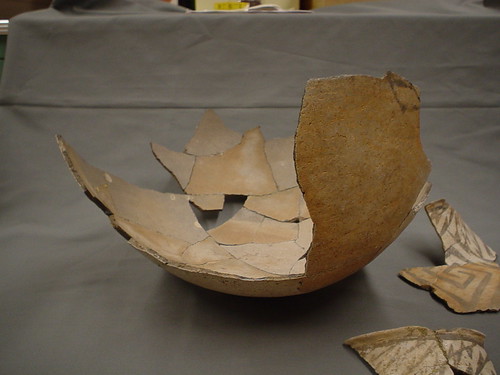
My best guess is that this bowl or pot was never a whole object in the collection. There was a donation of thousands of pottery sherds received in the 1970s, and I think the pieces making up this bowl came from that donation. This bowl is one of the objects which lacks any documentation. There is no number written on it, which is the primary way in which I can match an object to its records. Fortunately, this type of pottery is a very small percentage of our collection, so I can make some educated guesses about its history.
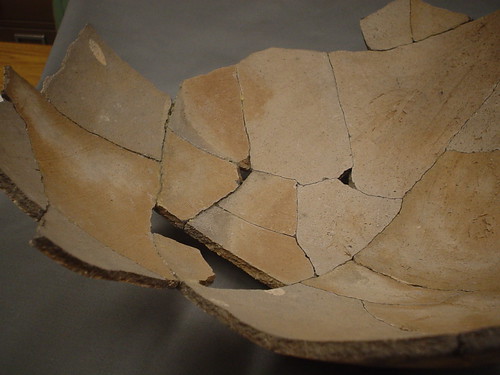
I believe that these pieces came to the museum in pieces and were reconstructed as a student project. In many areas, one can see the glue seeping through the cracks and yellowing.
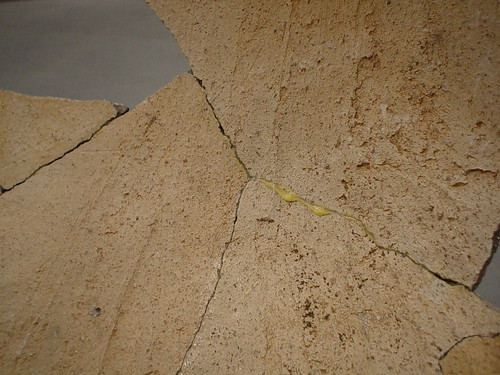
Most of the repairs seem reasonably secure, and I was able to lift it, but it makes me very very nervous to breath within a couple of feet of it. So what is going to happen to this bowl/pot? For the time being, it will be recorded as an undocumented object - an object that we might be able to find information on later, but don't have it right now - and taken care of as best we can. Deciding how to house it so it can be moved to a new facility will certainly be a challenge!
My best guess is that this bowl or pot was never a whole object in the collection. There was a donation of thousands of pottery sherds received in the 1970s, and I think the pieces making up this bowl came from that donation. This bowl is one of the objects which lacks any documentation. There is no number written on it, which is the primary way in which I can match an object to its records. Fortunately, this type of pottery is a very small percentage of our collection, so I can make some educated guesses about its history.
I believe that these pieces came to the museum in pieces and were reconstructed as a student project. In many areas, one can see the glue seeping through the cracks and yellowing.
Most of the repairs seem reasonably secure, and I was able to lift it, but it makes me very very nervous to breath within a couple of feet of it. So what is going to happen to this bowl/pot? For the time being, it will be recorded as an undocumented object - an object that we might be able to find information on later, but don't have it right now - and taken care of as best we can. Deciding how to house it so it can be moved to a new facility will certainly be a challenge!
Wednesday, July 9, 2008
Crystal Skulls and Glass Flooring
It's a quiet week here - I'm spending a lot of time processing digital photos for the database. We're also making headway in designing an actual website for the museum. This isn't an official date, but we're hoping to get it online by late August.
In the meantime, I keep up with museum news and blogs while I eat lunch, and two items caught my eye today.
More of the "crystal skulls" are forgeries. There was a big hullabaloo right about the time that Indiana Jones and the Kingdom of the Crystal Skull was released over one of the famous crystal skulls being fake. The revelation that it was a forgery prompted other institutions with crystal skulls to begin close investigation. And this article reveals that the skulls in the British Museum and the Smithsonian both have evidence of modern manufacture. Sorry, Indy.
The Brooklyn Museum is reflooring its Court. Way more interesting than it sounds. This blog post from the Brooklyn Museum shows how they are saving and re-creating a very cool glass floor in their popular Court. Lots of neat images of original floorplans and the undertaking to save the floor. Check it out!
In the meantime, I keep up with museum news and blogs while I eat lunch, and two items caught my eye today.
More of the "crystal skulls" are forgeries. There was a big hullabaloo right about the time that Indiana Jones and the Kingdom of the Crystal Skull was released over one of the famous crystal skulls being fake. The revelation that it was a forgery prompted other institutions with crystal skulls to begin close investigation. And this article reveals that the skulls in the British Museum and the Smithsonian both have evidence of modern manufacture. Sorry, Indy.
The Brooklyn Museum is reflooring its Court. Way more interesting than it sounds. This blog post from the Brooklyn Museum shows how they are saving and re-creating a very cool glass floor in their popular Court. Lots of neat images of original floorplans and the undertaking to save the floor. Check it out!
Monday, July 7, 2008
Back to work!
Here in the US, we're coming back to work after a long weekend. I've got a list of projects to tackle this week which include processing some objects which had not been cataloged or photographed, some database cleanup, and some filing. In the meantime, here are some photos of the new building, coming along nicely. I may have mentioned this, but the museum will not be occupying the entire building; instead, it will have a nice suite of spaces on the first floor. The Anthropology and Geography departments will make up much of the upper floors.
As always, click through for larger images.
The addition to the front of the building is coming along very nicely.
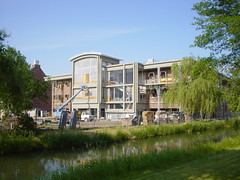
The bottom floor walls have been put up.
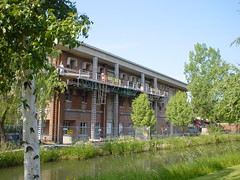
It's quite a dry region here; you can see what the grass would look like if it wasn't watered regularly (most of the campus is).
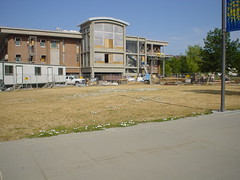
As always, click through for larger images.
The addition to the front of the building is coming along very nicely.
The bottom floor walls have been put up.
It's quite a dry region here; you can see what the grass would look like if it wasn't watered regularly (most of the campus is).
Thursday, June 26, 2008
Whatzit Answer: 6/20/2008
Whoops! I didn't mean Thursday when I told you that the answer to last week's Whatzit would be revealed early this week.
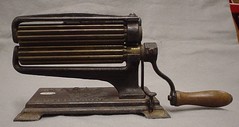
There were two excellent guesses as to what this strange contraption might be: A clothes drier or wringer, or a paper or cardboard crimper. Both are close in their own way: This contraption is a fluting iron.
A fluting iron was used to put crimps, pleats, or ruffles into petticoats in days of yore. So it has both to do with laundry and crimping - half points to both guessers. Most fluting irons were not so fancy as this hand crank model - they usually had a ridged base and a ridged curved handheld top part. This particular fluting iron is from right here in Ellensburg, WA and is part of the oldest and most diverse collection in the museum. It's exact history is not known, but one can easily imagine the pioneer families of the Kittitas Valley ordering a fluting iron from the city to bring a little bit of luxury to their lives.
You can see many kinds of historic irons in North Dakota State University's Emily P. Reynolds Historic Costume Collection.
There were two excellent guesses as to what this strange contraption might be: A clothes drier or wringer, or a paper or cardboard crimper. Both are close in their own way: This contraption is a fluting iron.
A fluting iron was used to put crimps, pleats, or ruffles into petticoats in days of yore. So it has both to do with laundry and crimping - half points to both guessers. Most fluting irons were not so fancy as this hand crank model - they usually had a ridged base and a ridged curved handheld top part. This particular fluting iron is from right here in Ellensburg, WA and is part of the oldest and most diverse collection in the museum. It's exact history is not known, but one can easily imagine the pioneer families of the Kittitas Valley ordering a fluting iron from the city to bring a little bit of luxury to their lives.
You can see many kinds of historic irons in North Dakota State University's Emily P. Reynolds Historic Costume Collection.
Friday, June 20, 2008
Science Friday!
I listen to NPR here at work quite a bit. Right now it's Talk of the Nation Science Friday, one of my favorite shows. There are two gentlemen from the Getty Conservation Institute discussing art conservation and the agents of deterioration. Should be quite interesting.
Podcasts are available, and this segment is running at the beginning of the second hour. Check it out if you want to learn more about preserving and conserving from some very experienced folks.
Podcasts are available, and this segment is running at the beginning of the second hour. Check it out if you want to learn more about preserving and conserving from some very experienced folks.
Subscribe to:
Posts (Atom)